
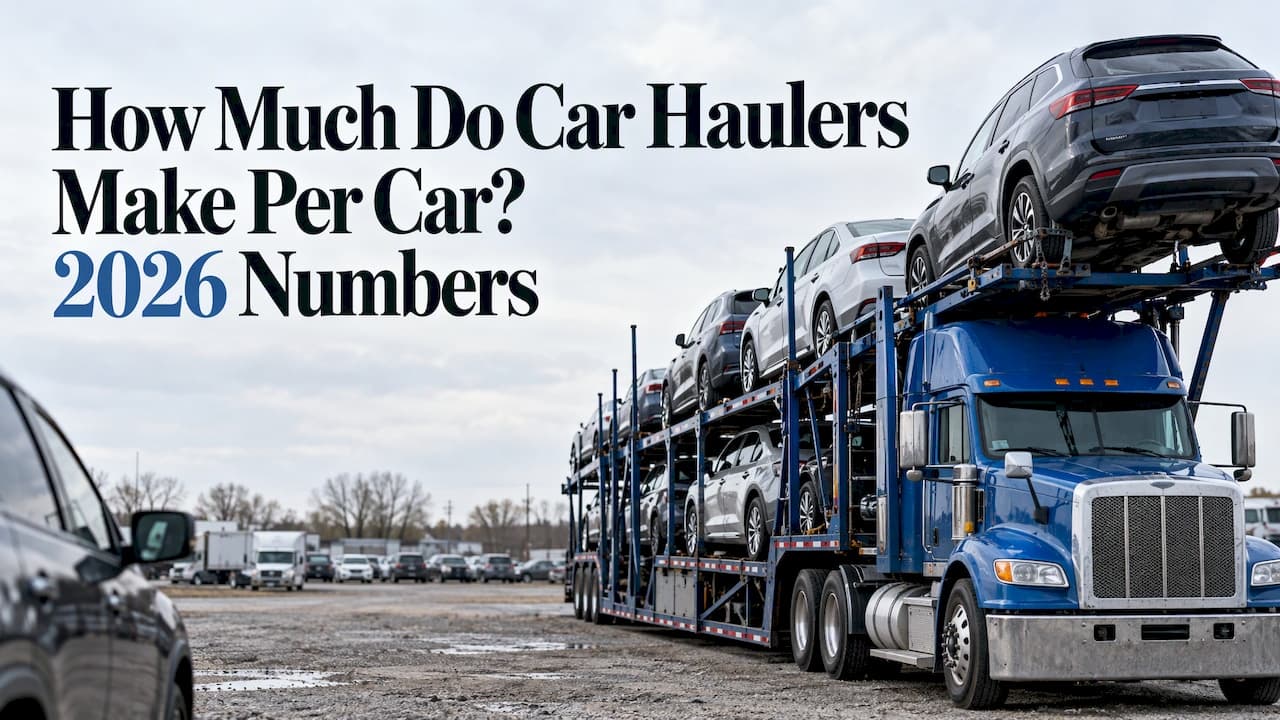
There is no fixed U.S. rate per car. Published 2026 guidance commonly puts open-carrier gross revenue at roughly $300 to $800 per vehicle, and what the owner-operator keeps after fuel, insurance, broker fees and equipment is often $150 to $250 per car. Where you land depends on the lane, the distance, how many slots you fill and who is paying. This guide shows how to read those numbers, so you can tell what a load really pays you.
TL;DR
- Gross per car on an open carrier usually runs $300 to $800. Net per car after expenses is often $150 to $250.
- Per-car pay shrinks as distance grows and as the trailer fills, so compare loads by total revenue per trip and per loaded mile, not just per car.
- Enclosed work pays more per vehicle, with higher equipment cost and fewer cars on the trailer.
- Company drivers commonly earn $65,000 to $114,000 a year. Owner-operators gross much more but carry every cost.
- Track each load's revenue, costs and driver pay in one place. That is how a gross figure turns into a profit figure you can trust.
Table of Contents
- Gross per car vs. what you actually keep
- Per-car pay vs. per-mile pay
- What moves your per-car number
- The costs that shrink the number
- Company driver vs. owner-operator income
- A worked example: is this load worth taking?
- Perspective
- Put your numbers in one place
- How to raise what you keep per car
- FAQ
- Sources
Gross per car vs. what you actually keep
Most numbers you see online are gross. Take the load payment, divide it by the cars on the trailer, and you have gross revenue per car. It is not profit.

A published 2026 example makes the gap clear. A nine-car open carrier on a 1,000-mile move can generate $6,000 gross, about $667 per vehicle, before overhead and broker deductions. The same source reports that open-carrier net can fall to roughly $150 to $200 per vehicle after overhead, and that broker fees may take 10% to 15% before the carrier is paid.
Here is that example as plain arithmetic:
| Item | Per load (9 cars) | Per car |
|---|---|---|
| Gross revenue | $6,000 | about $667 |
| Net at $150 to $200 per car | $1,350 to $1,800 | $150 to $200 |
The other half of the picture is that $667 is a good load. Another 2026 guide lists dealer-to-dealer owner-operator rates of $100 to $300 per vehicle and consumer relocations at $150 to $500. A nine-car load averaging $200 per vehicle grosses $1,800. Your own average per car depends on your customer mix.
Per-car pay vs. per-mile pay
Car haulers quote prices per car, but the truck earns per mile. The truck's rate per mile is the sum of every car on the trailer. One car at $0.60 per mile looks small. Eight of them is $4.80 per mile for the rig.
StartCDL reports that on hauls over 200 miles, payout ranges from $300 to $800 per car, on rates from $0.58 to $2.00 per mile. Trucking42 notes that on long cross-country moves, brokers might pay only $0.50 to $0.70 per mile per vehicle for standard cars on multi-car carriers, which still adds up to $3.50 to $5.00 or more per mile for a full truck.
Two rules follow from this:
- Short hauls pay more per mile and less per trip. Long hauls pay less per mile and more per trip.
- A per-car number is only meaningful next to the distance and the number of cars it came from.
To run the numbers on a specific lane, our rate per mile calculator turns a load price and mileage into a rate you can compare across offers.
What moves your per-car number
Load factor: how many slots you fill
This is the biggest lever you control. A 2026 owner-operator guide gives a nine-car, 1,000-mile example: five cars at $0.60 per mile per car earns $3,000, while eight cars earns $4,800. That is a 60% revenue increase with nearly identical trip costs, because the fuel, driver time and insurance are mostly the same either way.

Open carriers typically move seven to nine vehicles, while enclosed trailers carry two to six. Smaller wedge trailers commonly hold two to four vehicles, and large stinger-steer carriers roughly seven to ten.
Open vs. enclosed
Enclosed work pays more per vehicle. TransportVibe gives $1.50 to $2.50 per mile for enclosed work and an example of $1,800 gross for one vehicle over 800 miles. Another source says enclosed rates run 30% to 60% above open transport, but the equipment costs more, weighs more and often carries fewer vehicles.
| Open carrier | Enclosed carrier | |
|---|---|---|
| Typical capacity | 7 to 9 cars | 2 to 6 cars |
| Gross per car | roughly $300 to $800 | often $500 or more for high-value vehicles |
| Strength | Volume | Premium per vehicle |
| Cost profile | Lower equipment cost | Higher equipment cost |
The gross figure for enclosed comes from TransportVibe's net comparison, which says enclosed transport can earn $500 or more per vehicle for high-value cars.
Customer type
Dealerships, auctions, brokers and private customers pay differently. Dealer work tends to be steady and lower per car. Consumer relocations pay more per vehicle but need more coordination. Specialty and exotic enclosed work can command $1 to $3 per mile per vehicle. MaxxdTrailers reports that some haulers earn $300 to $600 per day running dealership routes, and that single specialty hauls such as classic or exotic cars can reach $1,000 or more.
Lane, season and deadhead
Route density matters. Auction corridors and ports tend to produce more loads, winter pushes snowbird traffic south, and month-end brings auction volume. Empty miles hurt: ATRI-related reporting says empty miles averaged 16.7%. Revenue is usually quoted on loaded miles, while fuel, tires and maintenance accrue on every mile.
The costs that shrink the number
Fuel, insurance, maintenance, taxes and permits, broker or dispatch fees, truck and trailer payments and deadhead all come out of gross. One illustrative per-car breakdown gives these ranges:
| Cost per car | Range |
|---|---|
| Fuel | $100 to $250 |
| Insurance | $50 to $150 |
| Maintenance | $40 to $100 |
| Taxes and permits | $30 to $80 |
| Broker or dispatch fees | $20 to $60 |
| Truck and trailer payments | $50 to $150 |
| Deadhead | $20 to $70 |
Those ranges come from CarXplorer's guide and are illustrative, not a quote for your rig.
For a per-mile check, ATRI-based data reported in 2026 puts the average Class 8 marginal operating cost at $2.336 per mile, including $0.482 fuel, $0.404 truck and trailer payment, $0.215 repair and maintenance and $0.106 insurance. That is general trucking data, not car-hauler-specific. It still gives a useful floor: over 1,000 miles, that is about $2,336 in running cost. Against the $3,000 five-car load above, that leaves little. Against the $4,800 eight-car load, it leaves a real margin. Note that the ATRI figure includes driver wages and benefits at $1.028 per mile, and when you drive your own truck, that portion is your own labor income rather than an outside expense.
One owner-operator scenario shows how monthly costs stack up: $255,000 annual gross, $175,000 expenses and $80,000 net, with fuel at $4,800 a month and insurance at $2,200. Self-employment tax then applies to net earnings. TruckingJobsInUSA cites 15.3% on net earnings, so talk to a tax professional about your own situation.
Company driver vs. owner-operator income
| Company driver | Owner-operator | |
|---|---|---|
| Typical annual range | $65,000 to $114,000 | Gross $200,000 to $350,000; net $70,000 to $150,000 |
| Pay structure | $0.45 to $0.75 per mile, or 25% to 35% of the carrier's pay | You keep the load revenue, minus costs |
| Who pays equipment costs | The company | You |
The ranges above are from TransportVibe's 2026 report. Other guides vary: one lists company drivers at $60,000 to $95,000, and Fleet Care Group puts owner-operator net at $75,000 to $180,000. The spread is wide because the inputs are wide: equipment, lanes and hustle.
A real listing helps anchor the low end. A Carvana auto-hauler job posted in August 2026 advertised average weekly pay of $1,400, company-paid medical insurance and home-daily work on five- or nine-car equipment.
If you run drivers rather than drive yourself, how you pay them matters as much as what you earn. Per-mile, per-car and percentage pay all change your margin. Our driver pay calculator lets you test each model on the same load.
A worked example: is this load worth taking?
Take two offers for a 1,000-mile run with an open carrier, using the sourced figures above.
- Load A: five cars at $0.60 per mile per car. Revenue is $3,000. Against a general trucking cost of $2.336 per mile, running cost is about $2,336. That leaves roughly $664 before broker fees and your own pay.
- Load B: eight cars at $0.60 per mile per car. Revenue is $4,800. Same running cost. That leaves roughly $2,464.
The cars are the same price. The difference is three more slots filled. That is why experienced haulers talk about density and backhauls before they talk about rate per car. Our load profit calculator does this arithmetic on your own costs, so the number you compare is profit and not gross.
Perspective
Most haulers we talk with can tell you what a load paid. Fewer can tell you what it earned. The gap sits in places spreadsheets handle badly: a broker fee here, a fuel receipt there, a driver settlement calculated at the end of the week from memory.
We built Dispatch Autopilot for car haulers, with hands-on industry experience behind it, because per-car pay only means something when you see revenue, expenses and driver pay on the same load. Every feature comes from a real-world need: entering a load quickly, inspecting vehicles with photos and location stamps, sending documents to brokers automatically, and settling pay without rebuilding the math each week.
Our view is simple. The haulers who pull ahead are not always the ones with the highest rates. They are the ones who know their numbers by lane and customer, fill the trailer, and get paid on time. One flat price per company, with unlimited drivers and trucks, means growing your fleet does not mean growing your software bill.
the author
Put your numbers in one place
Knowing the averages is the start. Your average is the one that counts, and it only shows up when each load is recorded the same way: revenue, trip costs, driver pay and payment status.
Dispatch Autopilot Pro combines load management, trip planning, vehicle inspections, invoicing, broker communication, driver settlements and expense and fuel tracking in one platform on web and mobile. It costs $100 per month per company or $800 per year per company, with unlimited drivers and trucks included. A free trial lets you see how it fits your operation first. See the Dispatch Autopilot Pro plans for details.

If you want to see where the time goes first, start with the car hauler dispatch software page, or look at how driver settlements and invoicing and BOL tools handle the weekly paperwork.
How to raise what you keep per car
You rarely control the rate. You control the rest.
- Fill the trailer. Going from five to eight cars on the same lane is the biggest single change in the examples above.
- Cut empty miles. Plan the return leg before you accept the outbound load. A trip planner that shows rate per mile for the whole route makes that easier.
- Know your cost per mile. Use your own fuel, insurance and equipment numbers, not an industry average.
- Mix your customers. Steady dealer work covers the base. Higher-paying consumer and specialty loads lift the average.
- Document every pickup. Photo inspections and signed bills of lading protect you when a damage claim or a late payment comes up. Our vehicle inspection app captures them on the phone.
- Settle pay fast and consistently. Drivers who trust their settlements stay longer, which saves recruiting and training cost.
FAQ
How much does a car hauler make per car?
On an open carrier, gross revenue is commonly $300 to $800 per car, depending on distance, lane and customer. After fuel, insurance, broker fees and equipment, net is often $150 to $250 per car. Enclosed and specialty work can pay considerably more per vehicle.
How much do car haulers make per year?
It depends on the role. Company drivers commonly earn $65,000 to $114,000 a year. Owner-operators can gross $200,000 to $350,000 and net $70,000 to $150,000 after expenses, based on TransportVibe's 2026 ranges. Your result depends on your load factor, lanes and costs.
Is car hauling a good business to get into?
It can be profitable, especially when you keep the trailer full and control deadhead. The upfront cost is significant, since you need a truck, a trailer, insurance and authority. Run your cost per mile and your expected loads before you commit, and talk to an insurance agent and a tax professional about your own setup.
Why does pay per car drop on long hauls?
Brokers and customers price longer distances at a lower rate per mile, even though the total per car goes up. Per-car pay rises with distance while per-mile pay falls. A 2025 network dataset of nearly 10 million shipments shows average rates per mile falling as trips get longer, so compare loads by total revenue per trip.
Sources
- TransportVibe: how much car haulers make per car
- CarXplorer: car hauler earnings per car guide
- StartCDL: car hauler salary in the United States
- Trucking42: how much you can make car hauling
- U.S. Truck Driver's Choice: auto hauler career guide
- U.S. Truck Driver's Choice: auto transport owner-operator guide
- U.S. Truck Driver's Choice: car hauler owner-operator earnings
- MaxxdTrailers: income with a car hauler
- Advanced Trucking: what owner-operators make in 2026
- Innovative Logistics Group: ATRI and empty miles
- TruckingJobsInUSA: how much truckers make
- Fleet Care Group: how much you can make car hauling
- Carvana auto hauler job listing